
Cold Feet at Night: The Sleep Guide
You are lying there. Blankets piled high. Socks on. And your feet are still freezing. You have tried everything. Extra blankets. Hot water bottles. Two pairs of socks. Nothing holds.
There is a reason this keeps happening. And there is a fix that works on the first night.
Why your feet are freezing at bedtime
Your feet might be fine all day and ice cold the moment you get into bed. That is not in your head.
Your body slows down
When you lie down, your body produces less heat. Even sitting at a desk generates more warmth than lying still. Your feet are the farthest point from your heart. When heat production drops, they feel it first.
Your blood pulls inward
During sleep, your body prioritizes your core: heart, lungs, brain. Blood flow to your feet and hands decreases. If your circulation is already marginal, this is the tipping point.
Women get hit harder
Women’s feet consistently measure colder than men’s in identical conditions. Smaller body mass, less heat. Estrogen narrows blood vessels in the extremities more aggressively. If you have always wondered why your partner sleeps fine while you are freezing, this is a large part of the answer.
Cotton is working against you
You know that sock that feels warm when you put it on, but by 2 a.m. your feet are colder than before? Cotton. It soaks up the sweat your feet produce overnight and turns into a damp, cold layer against your skin. Two pairs of cotton socks are not twice as warm. They are twice as damp.
Raynaud’s
Blood vessels in your toes overreact to cold and temporarily shut down supply. Toes turn white, blue, or red. 3–5% of the US population.
Read the guide →Poor circulation & PAD
Narrowed arteries restrict blood flow to your legs and feet. 8.5M+ Americans over 40. Often one of the earliest signs.
Read the guide →Hypothyroidism
A slower metabolism means less heat overall. About 4.3% prevalence. Cold extremities are a hallmark.
Read the guide →Neuropathy
Nerve damage changes how your feet sense temperature. They feel cold when they are not, or genuinely cold without you knowing.
Iron-deficiency anemia
Less oxygen reaches your tissues, less heat gets generated. Cold hands and feet, worst at night when everything else slows down.
When to see a doctor: toes that change color and don’t resolve. Coldness in one foot only. Numbness that worsens. Slow-healing wounds. Calf cramping during walking that stops when you rest.
The warmer your feet, the faster you fall asleep
This is one of the most consistent findings in sleep research over the past 25 years.
Your body needs to cool down slightly to fall asleep. About 1 to 2 degrees. And the way it cools down is through your feet. Warm feet allow blood vessels near the skin to open up, heat flows to the surface, and your core temperature drops. That drop is the signal your brain needs to switch into sleep mode.
A study published in Nature found that foot temperature was the single strongest signal for how fast someone fell asleep. Stronger than melatonin. Stronger than heart rate. Stronger than how sleepy they said they felt. Just the temperature of their feet.
Cold feet lock that system up. The blood vessels stay tight. Heat stays trapped in your core. Your brain never gets the signal. You lie there, waiting.
A later study tested this directly with bed socks. People who wore socks to bed fell asleep faster, slept about 32 minutes longer, and woke up less during the night.
A note on the research: that bed-sock study was small (six people), so the exact numbers are directional. But the underlying connection between warm feet and faster sleep has been confirmed by multiple research groups over two decades.
Practical tips
Two things most people get wrong about socks and sleep.
Put socks on before you get into bed
Most people reach for socks after they are already lying there with cold feet. By then, the feet are constricted. The socks are playing catch-up.
Put them on 20 to 30 minutes before bed. Let the warmth build while you are still reading or winding down. Your blood vessels need time to open up and start releasing heat. By the time you lie down, the process is already working.
If you wake up warm and kick them off during the night, that is fine. The socks did their job at the moment that mattered: the transition into sleep.
Why blankets alone are not enough
Three blankets and your feet are still cold. That is not the blankets failing. Blankets trap warmth, but they do not create it. If your feet go to bed cold, blankets hold that cold in place.
Your feet need their own insulation, close to the skin, trapping the warmth your body is producing right at the surface. A thermal sock does this. A blanket six inches away from your foot does not.
The combination works: socks warm the foot, blankets hold that warmth in. But the sock has to come first.
What fixes cold feet at night
You have probably tried some of these already. Here is what actually works, what does not, and why.
Common fixes that fall short
Hot water bottles
Feel great for an hour. Then cool down. Burn risk with neuropathy.
Electric blankets
Heat the whole bed, not your feet. Work against the core-cooling sleep needs.
Doubling cotton socks
Two wet layers are colder than one. Doubles the moisture, not the warmth.
Rice socks / heat packs
Cool down in 30 to 45 minutes. A head start, not a solution.
What actually works
Warm foot soak
60 to 90 minutes before bed, not right at bedtime. Raises your foot temperature and gets the blood flowing. One of the simplest things you can do tonight.
Light movement
A short walk or some gentle stretching. Five minutes of movement noticeably improves foot circulation before bed. Make it part of your wind-down.
Thermal socks
The material is everything. Cotton soaks up sweat and turns cold. Thermal acrylic pushes moisture away and holds warm air against your foot. No batteries. No burn risk. The warmth holds all night.
Why the sock material matters
The difference between a good night and a cold one often comes down to what your sock is made of. Both start warm. Only one stays warm.
Absorbs moisture. Turns cold.
Your feet sweat overnight, even at rest. Cotton soaks it up and holds it against your skin. Wet fabric pulls heat away instead of holding it in. The sock that felt warm at 10 p.m. is a cold compress by 2 a.m.
Repels moisture. Stays warm.
Pushes moisture away from your skin instead of absorbing it. A brushed pile traps warm air in thousands of tiny loops against your foot. Dry feet stay warm. The insulation holds through the night.
| Sock | TOG | vs. Cotton |
|---|---|---|
| Regular cotton sock | 0.3 | 1× (baseline) |
| Heat Holders ULTRA LITE™ | 1.0 | 3× warmer |
| Heat Holders LITE™ | 1.6 | 5× warmer |
| Heat Holders ORIGINAL™ | 2.3 | 7× warmer |
TOG measures thermal resistance: how well a fabric holds heat. These are lab-tested figures printed on the packaging. The ORIGINAL sock holds seven times more warmth than cotton. From the same slot on your foot. For a lot of people, this is the only change they need.
Not sure which sock is right for your bed?
Now you know why your feet get cold and how warm socks help you sleep. The next step is matching the right product to your situation. Three quick questions. One honest recommendation.
Which sock is right for your bed?
Three quick questions. One honest recommendation.
Socks and sleepwear for cold nights
Matched to your situation. TOG ratings apply to socks only.

Sleep Socks
Designed for bed. No grip soles, no bulk. Women's sizes 5-9.

ORIGINAL Crew Socks
The warmest sock in the range. Men's and women's.

LITE Socks
Warm enough for bed without the bulk. Men's and women's.
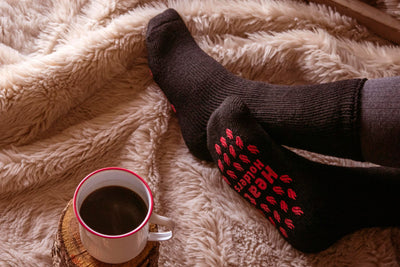
Slipper Socks
Thermal warmth plus non-slip grip. Men's, women's, kids'.

Pajama Sets & Pants
Flannel and microplush. Men's and women's.

Super Plush Blankets
Socks warm your feet. The blanket holds that warmth in.
The bedroom warmth system
Cold feet are usually the loudest complaint. But they are often part of a bigger picture. If your legs are cold, your core is cold, and the room temperature is working against you, socks alone are solving one piece of a four-piece problem.
The approach that works: think in layers. Each layer does a specific job. Together they create whole-body warmth without turning up the thermostat. Heating your body directly is cheaper and more effective than heating the room.
Feet
Thermal socks. The single highest-impact change for most cold sleepers.
Legs & core
Flannel or microplush pajamas. A warm core means your body stops pulling heat from your feet.
The bed
A blanket at the foot of the bed keeps the warmth your socks create from escaping.
The room
60–67°F. Insulate your body, cool the room. Better sleep, lower energy bill.
The partner problem
One person runs cold, the other runs hot. Higher thermostat, electric blanket, heavier duvet: every whole-room fix overheats the warm partner. Targeted warmth solves this. The cold partner wears ORIGINAL socks and flannel pants. The warm partner stays in a t-shirt. Both sleep.
What cold sleepers say
These are real reviews from real customers, pulled directly from our review database. Over 900 reviews mention sleep, bed, or nighttime warmth specifically. These are some of the people who solved the exact problem this guide covers.
Cold feet at night FAQ
Women are affected more. Estrogen narrows blood vessels in the extremities.
Cotton socks absorb sweat and turn cold. Medical conditions like Raynaud's, PAD, hypothyroidism, or anemia make it worse.
Choose moisture-managing socks, not cotton. Put them on 20-30 minutes before bed.
Bed only: sleep socks. Cold floors too: slipper socks. Avoid anything tight.
It is temperature, not anxiety.
Some people keep both: sleep socks for bed, slipper socks by the door.
But persistent cold feet can point to PAD, Raynaud's, hypothyroidism, anemia, or neuropathy. See a doctor if you notice color changes, numbness, or coldness in only one foot.
This is why sleep socks skew heavily toward women.
Thermal socks in a 64 degree room cost far less than heating the room to 72.


